Market Trends in SEO & Digital Marketing: What Actually Works
The market trends worth following are the ones that reduce acquisition friction and raise conversion certainty: structured content clusters, intent-aligned paid tests, and surgical technical fixes like Core Web Vitals and schema. By the end you’ll know which trends to pilot, which to ignore, and how to measure early success.
By the end of this piece you will be able to choose three market trends to pilot this quarter, design a 6-12 week test that proves or disproves ROI, and evaluate vendors using operational questions that surface competence. The keyword here is market trends — not fads — and we’ll treat each trend like a tradeoff with measurable checkpoints.
Which Market Trends Actually Move Revenue?
Marketers chase trends because they’re visible. What actually moves revenue is a trend that shortens the path from discovery to purchase and makes that path repeatable. We look for two things when deciding whether a trend is operationally useful: whether the trend improves relevance at scale, and whether it reduces conversion friction.
Short answer: Pilot trends that create reusable assets — content clusters, schema-enhanced listings, and high-intent paid tests — and ignore hype that only increases surface-level engagement without measurable conversion lift.
Why this matters. Trends that only raise impressions but add no conversion signal cost you time and money. What actually works is combining content that targets intent stages with programmatic technical signals such as structured data, then validating with paid channels to narrow-fit the buyer profile. In practice we see content clusters take 3-6 months to show durable organic movement, while paid tests can validate persona fit within 2-4 weeks if the landing experience matches search intent.
Operational signal to watch for: when an experiment improves both organic click-through rate and on-site conversion rate, that trend is repeatable. If it only lifts clicks with no conversion change, it’s a vanity trend.
Why Quality Content Still Outperforms Chasing Keywords
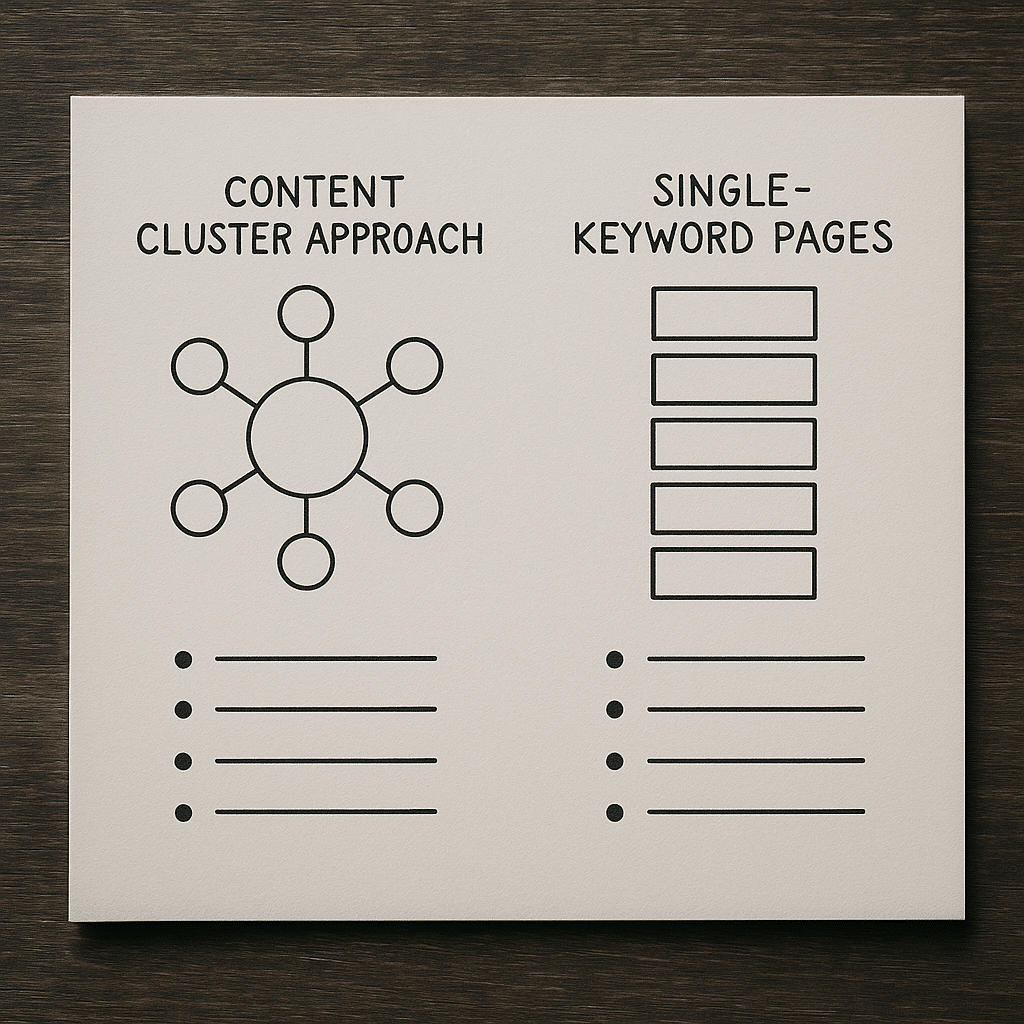
Content trends oscillate between short-form amplification and deep topical authority. The durable approach is to build reusable content clusters that map to customer journeys. That means fewer shallow pages optimized for single keywords and more hub-and-spoke structures optimized for intent bundles.
How it works. A well-built content cluster uses a pillar page to signal topical authority and spoke pages to capture micro-intent. Use internal linking that flows link equity from high-authority pages to conversion pages. Implement Schema.org markup on product and FAQ sections to extend SERP real estate with rich results.
Good vs bad. Good content clusters have three operational traits: coherent internal linking that passes topical authority, unique conversion opportunities on spoke pages, and analytics events mapped to intent stages. Bad clusters are vanity hubs with duplicate shallow content and no conversion hooks, which waste crawl budget and editorial resources.
WOW factor: migrating 40% of a site’s thin pages into 4–6 well-linked clusters often reduces editorial burden while increasing qualified organic visits. In practice, we prune and consolidate during the cluster build — that tradeoff is rarely described in high-level guides.
Tools and specs to use: Google Search Console to track query changes, PageSpeed Insights for performance, and Schema.org for structured data. For on-page testing, treat a content cluster like a product: baseline traffic, hypothesize intent, iterate titles and internal links, then measure cohort conversions across 3-6 months.
When Should You Use Paid to Accelerate Organic?
Paid and organic rarely compete when used correctly. Paid channels should be used as an experimental pressure test for organic hypotheses — not merely to amplify existing pages. Use paid to validate intent, refine messaging, and create conversion-optimized landing pages that can then be inherited by organic traffic.
Short answer: Use paid when you need fast, statistically meaningful signals about audience intent or landing page effectiveness; pause paid if landing experience fails to convert because it will amplify a false-positive.
How this looks in practice: pick one hypothesis — for example that a content cluster will convert mid-funnel leads — and run a narrow paid test targeting the same queries. Keep the test tight: one audience, one creative, and one landing page. If paid traffic converts, invest in organic scaling for that cluster. If it doesn’t, iterate the landing experience until both paid and organic meet conversion thresholds.
Numeric thresholds we use as guardrails: run paid tests for at least 2-4 weeks to reach signal, and expect meaningful conversion signals to appear after the landing page gets 200-500 engaged sessions — fewer sessions create noisy results.
Vendor question: ask your PPC team whether they will run paid-to-organic attribution experiments using UTM and conversion cohorts, not just top-line clicks. If they can’t map paid conversions to organic keyword intent, the test won’t teach you anything.
Internal link: For landing page conversion work we often coordinate with the Landing Page Design team; see our Landing Page Design Agency In Florida process for landing experiments and measurement.
Image failed to generate
Data visualization showing paid test funnel vs organic funnel conversion comparison
canceling statement due to statement timeout
Technical SEO Trends That Often Break Sites
Technical trends — server-side rendering, headless CMS, advanced caching — promise speed but often introduce regressions when implemented without a test plan. Common failure modes are misconfigured redirects after a migration and improperly applied hreflang or canonical tags that create duplicate content loops.
How it fails. A typical failure mode is a site migration where developers change URL structures without a 1:1 redirect map. Consequence: lost link equity, 301 chains that slow crawl efficiency, and pages dropping from index. That outcome is avoidable with thorough mapping and staged rollouts.
Concrete thresholds to watch: Core Web Vitals remain a technical checkpoint — Largest Contentful Paint under 2.5 seconds and Cumulative Layout Shift under 0.1 are performance thresholds recommended by web.dev and Google Search Central. Track pre- and post-release metrics in Google Search Console and PageSpeed Insights before and after deployment.
Tooling: use Google Search Console for index coverage, Screaming Frog for crawl simulation, and your CDN logs for cache hit ratios. We also rely on server logs to validate crawl behavior before trusting index signals.
WOW factor: in practice, a single overlooked 301 chain on high-authority pages can create a cascading traffic drop because link equity dilutes across the chain. That specific failure mode is mis-labeled as a content problem on discovery calls, but it’s technical in origin and fixable.
Internal link: If your project includes a site redesign, coordinate with a Website Redesign Company In Florida that has experience preserving SEO during migrations.
Image failed to generate
Infographic — process flow diagram illustrating safe site migration steps and technical checks
canceling statement due to statement timeout
Real Scenario: A 30-Page Local Retail Site with Limited Dev Resources
Scenario constraints: 30 pages, single-location retail in Phoenix, no in-house developer, limited paid budget, seasonal demand peaks. The objective is to increase qualified local footfalls and online appointments without a full redesign.
Proposed plan and why it works. First, consolidate duplicate pages and create two content clusters: store information plus product/service-specific buying guides. Second, add local schema and optimize Google Business Profile signals. Third, run a narrow paid search test aimed at high-intent local queries and direct that traffic to newly optimized pages.
Why this choice is tactical. Consolidation reduces maintenance; local schema increases SERP real estate; a targeted paid test validates whether the cluster converts. Operationally, this plan uses low-dev changes and prioritizes quick wins. In practice the pattern on jobs like this is that local schema plus clear call-to-action buttons increase qualified calls and appointments more reliably than adding new pages.
Failure mode to avoid: adding faceted navigation without canonical rules, which can create dozens of near-duplicate URLs. Consequence: wasted crawl budget and chaotic analytics data. If you have limited dev resources, avoid faceting until you can implement canonicalization and parameter handling.
Internal link: For local campaigns that include SMS follow-ups we integrate SMS channels and recommended workflows with our SMS Marketing Services; see SMS Marketing Services In Arizona for operational examples on appointment follow-up automation.
Image failed to generate
Checklist diagram for local retail SEO — tasks prioritized by impact and developer effort
canceling statement due to statement timeout
How to Evaluate Vendors and Spot Red Flags
Hiring the wrong vendor wastes budget faster than a bad tactic. Ask operational questions that require evidence, not slogans. Good vendors answer with processes, screenshots, and concrete KPIs tied to your business outcomes.
Short answer: Ask for process artifacts — crawl reports, redirect maps, A/B test designs, and an attribution plan — and treat vague promises about “increasing visibility” as a red flag if not backed by these artifacts.
What good looks like. A competent vendor will provide a sample crawl report, a prioritized technical backlog, a content cluster hypothesis with targeted queries, and a measurement plan mapping paid and organic conversions. They’ll also show how they handle migrations, including a redirect map and rollback plan.
Red flags. Avoid vendors who: refuse to show pre-signed examples, use vanity metrics as success criteria, or promise instant rankings. Also be wary if they lack engineers who can read server logs or if they can’t explain how schema and Core Web Vitals feed into organic visibility.
Practical questions to ask during a pitch: Can you show a redirect map from a past migration? How do you test Core Web Vitals in staging? Which analytics cohort will you use to prove organic lift? If they can’t answer with tools and steps, the vendor is likely selling tactics, not outcomes.
Internal link: For campaigns that require creative assets or brand alignment, coordinate with our Graphic Design Agency In Arizona or our Brand Messaging Consulting Services In Arizona to ensure landing pages match the ad creative and reduce conversion friction.
Image failed to generate
Comparison chart showing vendor deliverables that prove competence vs common vague promises
canceling statement due to statement timeout
Pros and Cons of Adopting New Market Trends
- Pros — Rapid learning, potential first-mover advantage on SERP features, precise audience fit. Cause: experimentation produces direct signals; Effect: early wins in niche queries; Consequence: improved conversion if landing experience matches intent.
- Cons — Resource distraction, ephemeral visibility boosts, higher operational complexity. Cause: switching tools and workflows; Effect: increased chance of technical regressions; Consequence: wasted budget without proper measurement.
- Trade-off example — adopting headless CMS can improve time-to-interaction but increases build complexity and risk of broken schema. Ask for staged rollouts and canary tests to mitigate that trade-off.
Image failed to generate
Infographic — pros and cons checklist for adopting new SEO and marketing trends
canceling statement due to statement timeout
Evaluation Checklist and Next Steps
Use this checklist to evaluate a trend or a vendor in a 30-minute session. Each checklist item is actionable and reveals operational competence.
- Hypothesis: Can you state the conversion-related hypothesis in one sentence? If not, don’t proceed.
- Measurement Plan: Is there a baseline, treatment, and cohort definition? Demand an analytics cohort that ties search queries to conversions.
- Timeframe: Do you have 3-6 months for organic tests and 2-4 weeks for paid tests? If timelines are unrealistic, pause.
- Technical Safeguards: Is there a redirect map, staging validation of Core Web Vitals, and server-log crawl simulation? If not, that’s a red flag.
- Deliverables: Ask for a prioritized backlog, not a long laundry list. Good vendors give 4 prioritized tickets with owners and acceptance criteria.
Internal links for immediate actions: if you need help with paid creative during a test, talk to our Paid Social Advertising Agency In Arizona. For PPC management that aligns with organic tests, see our Google AdWords Management Services In Arizona.
External guidance: follow implementation details in Google Search Central for structured data and indexing, and consult web.dev’s Core Web Vitals guidance for performance thresholds.
Frequently Asked Questions
How Long Before I See Results from Testing a New SEO Trend?
Short answer: Organic tests typically need 3-6 months to show durable ranking and conversion changes; paid tests can provide directional signals in 2-4 weeks if landing pages are optimized and traffic is sufficient.
To go deeper: Organic ranking moves slowly because search engines reassess relevance and authority over time. Use paid tests to validate messaging quickly, then let organic follow once you have a conversion-validated landing experience. Avoid doubling down on paid signals that don’t convert.
Is Investing in Core Web Vitals Still Necessary?
Short answer: Yes, because Core Web Vitals are a performance signal that affects both search ranking and user experience; ensure Largest Contentful Paint and Cumulative Layout Shift meet recommended thresholds for low-friction pages.
To go deeper: Improving technical performance reduces bounce and increases the chance a visit converts. Implement lazy-loading, optimize critical CSS, and test in staging. Use PageSpeed Insights and field data from Google Search Console to prioritize fixes.
Should I Focus on Short-Form Video for SEO?
Short answer: Short-form video is valuable for acquisition and brand affinity, but treat it as a channel-level test tied to specific conversion goals rather than an SEO substitute.
To go deeper: If you have a conversion-optimized landing page, short video can lift ad engagement and organic branded search. Coordinate video content strategy with landing pages and analytics. For execution at scale, see short-form production workflows like Short Form Video Content Services In Florida.
How Do I Prevent Migrations from Hurting Rankings?
Short answer: Create a 1:1 redirect map, validate staging Core Web Vitals, run a crawl comparison pre- and post-launch, and monitor index coverage closely in Search Console after launch.
To go deeper: Use Screaming Frog to compare crawls, export the redirect map as an artifact, and run canary releases if possible. If a rollback is needed, ensure you have the original mapping and a tested revert plan to restore link equity quickly.
What’s a Red Flag in an SEO Proposal?
Short answer: Vague promises about “increasing visibility” with no measurement plan, no sample deliverables, and no technical validation steps are red flags you should avoid.
To go deeper: Require the vendor to present a sample crawl report, an analytics cohort plan, and a prioritized backlog. Ask for specific KPIs tied to revenue, not just impressions or rankings.
How Should Small Teams Prioritize Trend Adoption?
Short answer: Prioritize trends that are low-dev and high-impact first — content consolidation, local schema for local businesses, and paid-to-organic tests — then expand to higher-effort trends if early signals are positive.
To go deeper: Use a 2×2 prioritization matrix: impact versus effort. Start with items that live in the low-effort, high-impact quadrant and require measurable hypotheses and timelines before scaling.
Conclusion: The Single Most Useful Takeaway
Focus experiments on trends that produce reusable assets and measured conversion improvements — content clusters, schema, and paid-to-organic tests. Start with a tight hypothesis, a measurement plan, and technical safeguards. Next step: run one 8-week paid-to-organic experiment and demand the vendor show the redirect map and analytics cohorts before signing the scope.
Internal link: If you want to pilot an integrated experiment combining landing pages, paid tests, and follow-up automation, review our Event Marketing Agency In Arizona workflows for coordinating multi-channel campaigns and conversion tracking.
Image failed to generate
Checklist diagram for running an 8-week paid-to-organic experiment with vendor deliverables and measurement points
canceling statement due to statement timeout