Cost Optimization in SEO & Digital Marketing: Practical Tactics That Actually Save Money
Cost optimization means reallocating spend and operational effort to channels and tasks that produce measurable outcomes, not slicing budgets indiscriminately. By the end you will be able to run three low-risk experiments, evaluate whether cuts will damage organic momentum, and use a checklist to vet vendors and internal trade-offs.
You will be able to decide which programs to pause, which to accelerate, and how to measure the impact without guessing. Read fast if you need an immediate decision framework, or dig into the examples and checklist to negotiate with your agency or CFO.
Where Most Cost Optimization Fails
What usually happens is leaders ask for “a quick 20% cut” and agencies respond by reducing obvious line items — content, link building, A/B tests. That saves an invoice now but shifts cost into the product funnel: traffic drops, conversion tests stop, and the sales team loses pipeline visibility. The failure mode is not the cut itself; it’s the way cuts fracture value chains so attribution breaks and reactionary spending follows.
How it breaks, technically:
– Redirect chains, duplicated faceted URLs, and unpruned category pages multiply crawl cost and cause Googlebot to spend budget on low-value pages. In practice we see sites with thin product pages lose indexation after aggressive pruning if redirects and canonical rules aren’t applied.
– Misclassifying conversions in paid channels causes automated bidding to optimize for micro-actions that don’t move revenue. The consequence is overspend on high-volume low-value events while true pipeline metrics stagnate.
– Keyword cannibalization from templated title tags (category page and blog using identical headers) creates internal SERP competition and dilutes organic click-through rate.
Tools to diagnose these failure modes: Google Search Console for impression and index reports, Screaming Frog for redirect chains and URL surface analysis, Lighthouse for Core Web Vitals. Use these to avoid cutting the wrong thing.
How Much to Cut Without Breaking Organic Growth?
Most cuts are safe if they are selective, reversible, and measured against a 3-6 month stabilization window. The short answer is: pause non-strategic activity and reallocate to fixes that prevent value leakage, not just to cheaper channels.
Short answer: Reduce discretionary spend on experimental channels, preserve pillar content and technical SEO fixes, and plan for a 3-6 month window to judge impact.
Why that works: search momentum and indexation take time to adjust. If you pause content production entirely you lose the steady influx of internal links and topical signals that help new pages rank. Instead, follow a triage: keep core pillar pages (the topics that directly map to your product or service), postpone long-tail content that is expensive to research, and accelerate technical fixes that recover existing traffic.
Practical thresholds we use when triaging pages: maintain at least 5-15 core pages per product or service pillar that contain unique value (differentiated copy, clear schema markup, conversion paths). Pause new long-form content until you confirm technical health.
Three Cost-First Experiments That Pay Back
Run experiments that either recover lost value or prove a cheaper alternative. Each experiment must be timeboxed and instrumented so you can reverse course within 8-12 weeks if it underperforms.
Prioritize Pages Using Internal Search and Conversion Data
Why: internal site search shows intent at scale. How: pull 6-12 months of internal search queries and match them to existing landing pages. If users search X and land on a non-optimized page, update that page instead of creating new content. What good looks like: increased conversion rate on updated pages and fewer searches leading to zero-result pages. What bad looks like: creating low-volume new pages that never receive traffic.
Prune or Fold Low-Value Pages — with Redirects
Why: holding thin pages increases crawl noise and maintenance cost. How: identify pages with no inbound links, no organic sessions, and no conversions over 6-12 months; then canonicalize, 301 redirect to the nearest topic, or noindex,follow where appropriate. Failure mode: pruning without proper redirects or link cleanup causes 404s and immediate ranking drops. Recovery path: implement server-side 301s and update internal linking to preserve link equity.
Switch a Portion of PPC to High-Intent Landing Pages
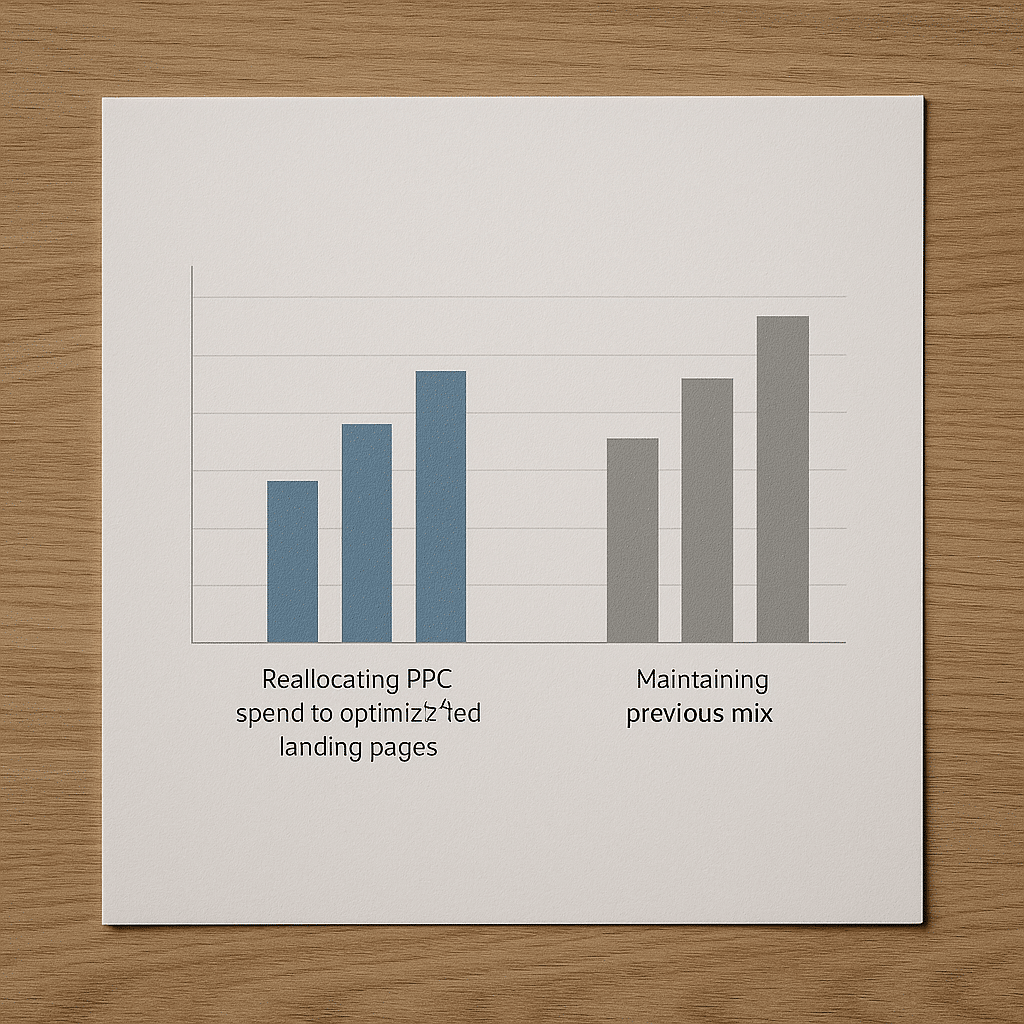
Why: lowering CPC alone isn’t a sustainable savings tactic. How: move 10-30% of PPC traffic to newly optimized landing pages tied to a single CTA and run one sprint of CRO tests. Measure cost per closed-won lead, not cost per click. Good results mean you can scale down volume but increase quality. Bad results mean you misaligned creative or the offer.
What Signals Prove a Cost Optimization Is Working?
Measure changes that tie to outcomes instead of vanity metrics. Directional improvement within a defined window proves a good move; the absence of deterioration proves a safe cut.
Short answer: Track organic impressions, organic clicks, conversion rate on retained pages, and pipeline metrics, and expect a directional signal within 8-12 weeks after an experiment.
Operational detail: set up an experiment cohort and a control cohort. For pruning, compare indexed pages and impressions in Search Console for the control vs. the trimmed cohort. For paid-to-landing reallocation, compare lead quality, not just CPL. If organic clicks drop but conversions remain stable or improve, you optimized cost without harming revenue. If clicks and pipeline both fall, reinstate the prior state and investigate link equity loss or cannibalization.
Tools and specs: use Google Analytics event-driven funnels, log server 301 responses to ensure redirects resolve correctly, and monitor Core Web Vitals via Lighthouse and real-user metrics. Core Web Vitals are a named standard you should be tracking because performance regressions can amplify ranking volatility after cost changes; small regressions can have outsized effects when combined with fewer content signals.
Real-World Scenario: 12-Person B2B SaaS with a $5K Monthly Marketing Budget
Constraints: small in-house team, limited paid budget, reliance on demos and trials for revenue. The question: where to cut without killing pipeline?
Step-by-step plan we use in practice:
1) Freeze experimental channels that are lowest ROI and reassign one content writer to technical SEO fixes and landing page optimization.
2) Run an internal search audit to retarget existing pages for product queries.
3) Reallocate 20-30% of PPC to branded and high-intent non-branded terms that go to single-purpose landing pages, then A/B test headline and form length for 4 weeks.
4) Use a focused link outreach sprint on 5 core pillar pages rather than a broad link subscription service.
5) Track pipeline impact weekly and keep a 3-month runway before making permanent decisions.
Why this specific plan: B2B SaaS pipelines convert slowly, and spending on awareness content often has a long lead time. We prioritize fixes that protect existing funnel signals and increase conversion efficiency per lead. Failure mode we watch for: pausing content drives short-term cost savings but reduces demo requests in 8-12 weeks — you must leave enough topical coverage so sales still has inbound opportunities.
Services that support this scenario: if you need a landing-focused redesign, a Website Redesign Company In Florida can consolidate pages into higher-performing templates, and a Landing Page Design Agency In Florida can execute rapid A/B tests. If PPC requires tighter management, a Google AdWords Management Services In Arizona partner can reset bidding and conversion classification.
Quality Evaluation Checklist Before You Cut Anything
Ask these questions to evaluate risk. Each item prescribes what good evidence looks like and what to do if it’s missing.
- Is the page or channel tied to pipeline outcomes? Good evidence: tracked conversions or lead attributions. If missing, instrument the funnel before cutting.
- Have you audited redirects and canonical tags? Good evidence: Screaming Frog crawl shows no chain longer than one hop and canonical targets are sensible. If missing, fix redirects first.
- Are conversions properly classified in paid accounts? Good evidence: a clear mapping between macro conversions and CRM closed-won. If missing, align events to revenue before changing bids; work with a Google AdWords Management Services In Arizona specialist if needed.
- Does removing content create orphaned internal links? Good evidence: internal link report confirms no lost navigation entry points. If missing, update links or add redirects.
- Is site performance stable? Good evidence: Core Web Vitals scores and server response time are steady. If missing, prioritize Front-end and hosting fixes and involve a Website Redesign Company In Florida where necessary.
- Do you have a measurement window and rollback plan? Good evidence: documented 8-12 week test period, success/failure thresholds, and a restoration path. If missing, don’t cut.
- Vendor health: are they transparent about where savings are coming from? Red flags: vague line-item reductions without impact analysis. Consider switching to a partner like a Paid Social Advertising Agency In Arizona that provides channel-level reporting or consult a Graphic Design Agency In Arizona for creative efficiency.

Common Misconception: Cost Optimization Means Cutting Anything with a High Invoice
People often think the biggest line item is the easiest place to save. That’s wrong because it ignores value density — the ratio of outcomes to spend. Cutting a big vendor without understanding what they deliver causes hidden costs: lost institutional knowledge, broken workflows, and months of reimplementation.
Why that’s wrong in practice: high-cost vendors frequently manage complex orchestration that appears expensive but prevents expensive failures. Instead of firing first, scope what the vendor actually does, demand monthly outcome reports, and ask for a 30-60 day transition plan if you intend to replace them. If you must reduce spend immediately, negotiate a temporary scope reduction that preserves core guardrails: analytics, redirects, and conversion tracking.
What to Do Next
The single most useful takeaway: treat cost optimization as a controlled experiment, not an accounting exercise. If you can’t prove an improvement or at least no deterioration within 8-12 weeks, restore the previous state and reassess. Start with technical hygiene and measurement — that buys you the runway to cut or reallocate safely.
If you want a short engagement that implements this approach, consider combining a focused landing page sprint with technical SEO triage and tighter PPC conversion mapping. For landing pages and design work, review Landing Page Design Agency In Florida and Website Redesign Company In Florida options. For tighter ad control, consult Google AdWords Management Services In Arizona.
Image failed to generate
Infographic — flowchart showing experiment setup: hypothesis, measurement window, decision points, rollback plan
Image generation stalled and was auto-recovered. Click Retry to try again.
Frequently Asked Questions
How Long After a Content Cut Will Organic Traffic Show Effects?
Short answer: Expect directional effects within 8-12 weeks; full impact on rankings and pipeline can take 3-6 months depending on site authority and index frequency. To go deeper, monitor Search Console impressions and clicks weekly, but judge conversions and pipeline over a quarter to capture lagging indicators.
Can Pruning Old Pages Actually Improve SEO Performance?
Short answer: Yes, when pruning reduces crawl noise and consolidates link equity into higher-value pages. To go deeper, always implement 301 redirects or canonical tags and measure indexation, impressions, and conversions for the target pages to ensure equity transfers.
Is Pausing Paid Acquisition a Reliable Way to Save Money?
Short answer: Pausing can save spend immediately but risks losing keyword ownership and brand visibility; re-entry costs can be higher. To go deeper, pause lower-intent campaigns first and preserve brand and high-intent ads; align bids and conversion tracking with CRM outcomes before broader pauses.
What Are the Fastest Technical Fixes That Protect Traffic?
Short answer: Fix redirect chains, enforce canonical tags, and stabilize Core Web Vitals. To go deeper, use Screaming Frog to identify redirect chains, Lighthouse for real-user metric regressions, and prioritize server-side 301 implementations to minimize ranking volatility.
How Should I Measure Vendor Proposals for Cost Reduction?
Short answer: Require clear KPIs, a measurement window, and a documented rollback plan before approving scope cuts. To go deeper, ask vendors to map each line item to a metric and to show past examples of reversible cuts; prefer short-term Sprints over indefinite scope cuts.
Where Do I Find Authoritative Guidance on Technical SEO Metrics?
Short answer: Google’s Search Central and performance guidance on Core Web Vitals provide primary technical guidance for indexing and user experience. To go deeper, use Google Search Central for indexing documentation and web.dev for Core Web Vitals recommendations, and combine those with server logs and Lighthouse lab tests to form a prioritized backlog.
External resources: consult Google Search Central for indexing and markup guidance and web.dev Core Web Vitals for performance thresholds. For budgeting discipline and prioritization templates, the U.S. Small Business Administration provides frameworks for market research and competitive analysis at SBA.
Internal resources referenced: consider pairing tactical work with a Website Redesign Company In Florida for technical fixes, a Landing Page Design Agency In Florida for CRO-driven pages, or a Google AdWords Management Services In Arizona partner to realign paid spend. For creative efficiency that reduces production cost, a Graphic Design Agency In Arizona can produce reusable templates, and if you pivot to social channels, a Paid Social Advertising Agency In Arizona can run targeted experiments.
Evaluation Checklist (Action Now): 1) Run a crawl and internal search audit; 2) Identify 5-15 pillar pages and protect them; 3) Document 8-12 week measurement windows; 4) Ensure 301/canonical cleanup before pruning; 5) Reassign at least one resource to measurement. Then run one of the three experiments above.
If you want a prioritized 8-week roadmap based on an initial audit, request a focused triage that combines technical fixes with one CRO sprint and a reallocated PPC cohort. Optimize with confidence.